Held in the Ground: How the Open Skies of Mughal Miniatures Are Rewriting the American Canvas
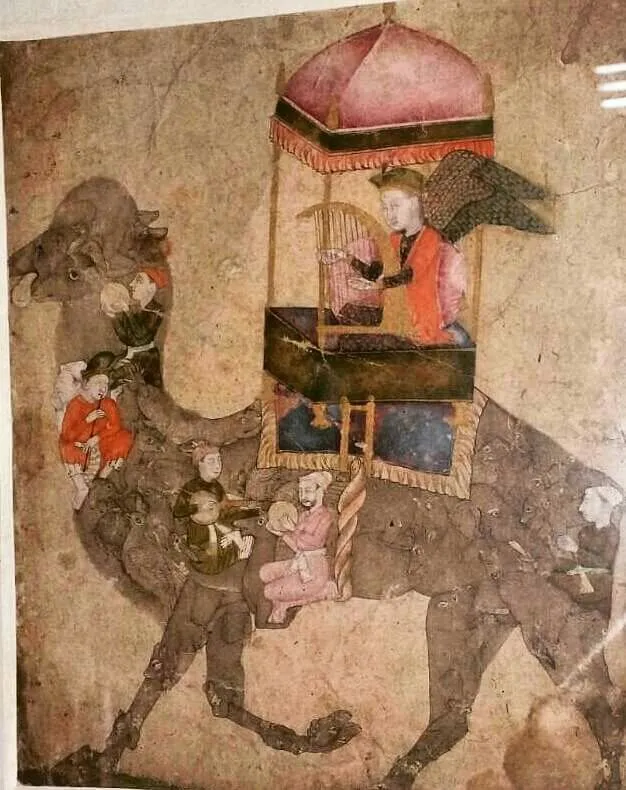
Photo: SpeakingArch, CC BY-SA 4.0, via Wikimedia Commons
There is a moment, familiar to anyone who has stood before a Pahari miniature, when the eye stops searching for detail and simply sinks. A lover waits beneath a flowering branch. A prince listens to a musician. And all around them — above them, behind them, pressing gently against them — is a field of color so complete it seems to hum. No clouds. No horizon line. No sky, strictly speaking, at all.
American painting has long treated that kind of space as a problem to be solved. Our traditions, from the Hudson River School to the WPA murals, have been taught to fill, to render, to justify every square inch. But something is shifting in studios from Marfa to Portland: a growing number of painters and illustrators are looking at those luminous, figure-holding grounds of the Mughal atelier and seeing not absence, but the whole point.
A Ground, Not a Background
In the workshops of the Mughal courts and the hill kingdoms of Kangra and Basohli, painters did not think in terms of backdrop. The term of art is ground — the prepared field of hand-ground pigment, often lapis lazuli or indigo, sometimes saffron-washed gold, upon which the subject floats. The ground was burnished to a sheen; it caught candlelight and moved with it.
What looks like emptiness is, in fact, the painting's emotional engine. A lover set against a swelling field of blue is not merely placed — she is weathered. The ground registers longing the way a sky registers an approaching storm. Scholars of the tradition have long noted that these fields function almost like the sustained note of a raga: a single held color against which every small gesture of the figure acquires weight.
That is a fundamentally different proposition from the Western void — Rothko's sublime, Yves Klein's patented blue. The miniature ground is not a void into which the self dissolves. It is a climate in which a human being is held.
The Studio Migration
Brooklyn-based painter Meera Raghavan first encountered the technique through a facsimile album in a university library in Chicago. "I kept thinking the flat fields were a printing limitation," she says. "Then I saw the burnish marks up close. Someone sat there and polished that blue for hours. It changed what I thought a background could do."
Raghavan now prepares her own grounds with gum arabic and crushed pigment, a process she describes as "the opposite of content creation." Her recent series — single figures suspended in fields of unbroken teal and oxblood — has drawn attention from book designers; two literary imprints in New York have commissioned covers built on the same logic, letting one small human form carry an entire jacket of undiluted color.
Illustrator Daniel Okafor, working out of Los Angeles, came to the tradition from the other direction — through contemporary graphic novels. "In comics we're trained to render environment or lose the reader," he explains. "The miniatures taught me that atmosphere doesn't need architecture. A figure against a held color reads as loneliness, or rapture, or dread, depending entirely on the temperature of that field. It's the cheapest special effect in the world and the hardest to earn."
Okafor's latest cover work — for a widely reviewed debut novel about a family scattered across three continents — places a solitary child against a ground of unmixed ultramarine. The art director's original brief asked for a city skyline. Okafor sent a single alternative. It ran unchanged.
The Discipline of Holding Back
What unites these American adapters is not a style but a stamina. Preparing a miniature-style ground is slow, repetitive, unfashionable work — grinding, layering, burnishing — in an art market that rewards velocity and novelty. Several of the painters interviewed for this piece described the practice in almost devotional terms, a word that is not accidental. The original grounds were made in workshops where painting and prayer shared a vocabulary.
There is also a quiet argument embedded in the work. At a moment when American visual culture is saturated — feeds, billboards, algorithmic maximalism — a canvas that offers a single figure in a single field of color makes a claim about attention. It trusts the viewer to bring something. It refuses to do the emotional labor for them.
The site you are reading takes its name from shoonya akar — the shape of emptiness, the form of zero. The miniature painters of the Mughal and Pahari worlds understood something that phrase tries to hold: that the unpainted is not the unfinished. The blue that isn't a sky, the ground that refuses to become scenery, the vast field that simply holds — these are not gaps in the composition. They are the composition.
The American painters learning this now are not copying a tradition. They are inheriting its hardest lesson: that sometimes the most generous thing a picture can do is leave most of itself unmade — and trust that a single figure, set in a field of patient color, is enough to carry the whole weight of the weather.