The Last Page Says Nothing: Inside the American Novel's Emptiest Ending
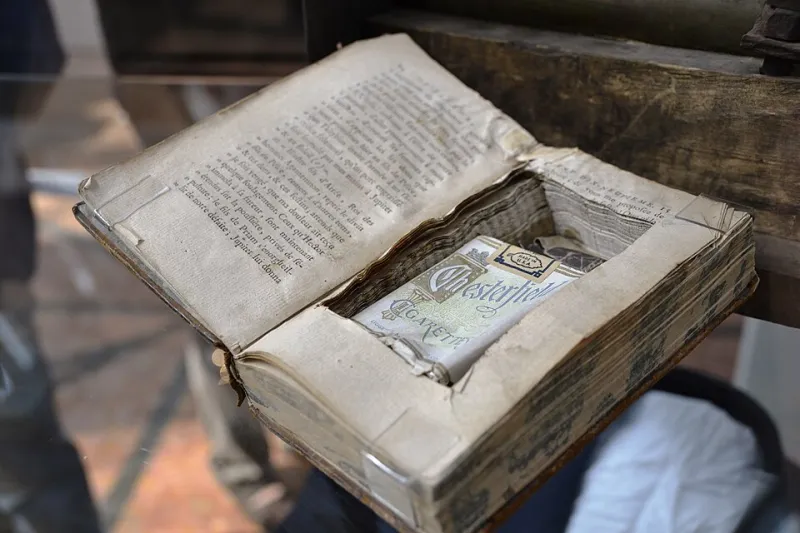
Photo: High Contrast, Public domain, via Wikimedia Commons
Where the Ink Stops
There is a moment, familiar to any devoted reader, when the thumb outruns the eye. You are turning pages faster than you are reading them, carried by momentum toward the end — and then the story is over, but the paper is not. Two, three, sometimes a dozen blank pages remain before the back cover. Most readers flip past them without a thought. A smaller, more vocal group has begun to wonder whether those pages are accidents at all.
Across American publishing, a quiet experiment is underway: novelists, essayists, and graphic novelists are ending their books with deliberately blank pages — not the typographical padding that once filled out a signature, but emptiness presented as statement. The final page of one recent literary novel contains nothing but the ghost of the previous page's ink, a faint bleed-through the designer admitted she preserved on purpose. A graphic novel published in Portland closes on an unmarked panel, white space where resolution should be. Readers have taken to Goodreads and BookTok to argue about what these endings mean — and, more pointedly, whether they are allowed to feel cheated.
The Śūnya Precedent
To understand why emptiness at the end of a book lands so differently in 2020s America, it helps to look further back and further east. Indian poetics has long treated the unsaid as a formal device rather than a failure. The concept of śūnya — the void, the zero — is not mere absence but a generative space, the field from which meaning emerges. Classical Sanskrit aesthetics prized dhvani, the resonance that lives beyond the literal line. Kabir's poems frequently trail off mid-thought, the dangling line itself a teaching: completion belongs to the reader, not the poet.
American writers did not invent the blank ending, but they may be the first generation to publish it into an ecosystem that demands resolution. The five-star review that begins "loved it, but the ending made no sense" reflects a market expectation: a novel should close its accounts. The blank ending refuses the audit. It says, in effect, the book is not finished because books never are — you were always the co-author.
What the Editors Say
Speaking on condition of candor, a senior fiction editor at a New York house describes the phenomenon as "a small but real trend — maybe a handful of titles a year, but the conversations around them are outsized." She distinguishes between two species of blankness. The first is structural: pages left empty to mark a passage of time, a death, a silence in the narrative. The second is philosophical: the book that ends on emptiness as its final argument.
"The structural kind is as old as the form," she notes. "The philosophical kind is riskier. It works when the whole book has been earning it. It fails, spectacularly, when it reads as a shrug."
Book designers occupy a peculiar position in this debate. The blank page, one designer explains, is never truly blank — it has texture, shade, the faint impression of the sheet. In print, an empty ending can feel like held breath. On a Kindle, it can feel like a malfunction.
The E-Book Problem
That is the fault line the blank ending has yet to survive. On paper, emptiness is physical: you can feel the pages, see the paper grain, sense the weight of what is not there. On a screen, a blank page looks identical to a loading error. Several authors interviewed for this piece admitted their publishers asked them to "signal" the intentional blankness in digital editions — an author's note, a single centered mark, anything to prevent the one-star review that says "my copy was defective."
Some have refused. One novelist, whose book ends with eleven empty pages, insisted the e-book version remain untouched. "If the reader thinks their device is broken," she said, "that confusion is part of the work. The void doesn't apologize for itself." Her publisher, less poetically inclined, added a disclaimer.
Invitation or Insult?
The readers, as ever, are divided. In informal conversations at independent bookstores in Brooklyn, Chicago, and Seattle, the responses split along predictable lines. Some found the blank ending "generous — the book trusted me." Others used the word "lazy." One bookseller offered the most useful frame: "A blank ending is a mirror. Readers who like what they see keep the book. Readers who don't blame the glass."
There is a case to be made that the trend, however small, matters. In a cultural moment saturated with content, with algorithms trained to serve the next thing before the current thing ends, the blank page is a radical act of slowness. It asks the reader to sit with incompleteness — to let the zero do its work. Whether American publishing, with its quarterly statements and its completion metrics, can afford such emptiness is another question.
The Shape of Not-Ending
The name of this publication means, roughly, the shape of emptiness — śūnya akar. It is a paradox that Indian thought resolved centuries ago: nothing, properly held, is a form. The blank final page is that paradox bound in a trade paperback. It will not dominate bestseller lists. It does not need to. It needs only to survive the scroll, the review, the e-reader's indifferent white screen — and to keep asking the oldest question in the reader's hand: what happens now?
The honest answer, the one the blank page has always known, is that it is up to you.