Drawn for the Dust: Why the Vanishing Rangoli Holds a Lesson American Streets Have Forgotten
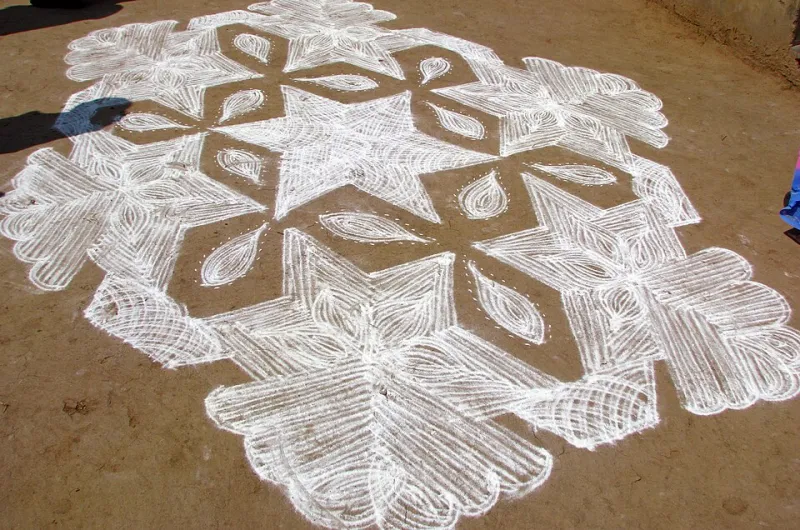
Photo: mckaysavage, CC BY 2.0, via Wikimedia Commons
The Artwork Scheduled to Disappear
Before sunrise in Chennai, Hyderabad, or a courtyard in Pune, a woman bends low with a fistful of rice flour and draws. A kolam, a rangoli — looping geometry, symmetrical blooms, lines that cross and never break. By evening it will be scuffed by sandals, scattered by sparrows, swept away. And that is not a failure of the medium. That is the medium.
In the philosophy from which Shoonya Akar takes its name, the empty threshold is not unfinished. It is the point. The rangoli begins from nothing, returns to nothing, and the beauty lives entirely in the interval. Permanence was never the ambition; presence was.
Now consider the American street. We gild our public art in anti-graffiti coating. We hold ribbon-cuttings, insure the murals, restore the bronzes. The assumption underneath all of it is that value requires duration — that a thing must outlast its maker to matter. The rangoli, practiced daily across the subcontinent for centuries, has always disagreed.
A Short History of Deliberate Impermanence
Floor art in South Asia predates the written record. Kolam traditions in Tamil Nadu, alpona in Bengal, rangoli across northern India — these are not decorations but daily devotions, drawn at the boundary between home and world. The materials insist on ephemerality: rice flour, ground limestone, colored powders, flower petals. Rain dissolves them. Traffic erases them. Tomorrow, the hand returns.
Scholars of the form note that the impermanence is theological as much as aesthetic. To draw knowing it will vanish is a rehearsal of non-attachment. The zero — shoonya — that Indian mathematics gave the world is not merely a placeholder. It is a fullness that contains everything by holding nothing.
American public art, by contrast, was born from the opposite impulse. The monuments of the nineteenth century, the WPA murals of the Depression era, the contemporary mural boom from Philadelphia's Mural Arts Program to the painted alleys of Denver — nearly all of it is engineered against time. Sealants, UV protectants, restoration funds. We build public art the way we build memorials: to refuse the ending.
The Americans Drawing to Be Erased
Yet something is shifting on the pavement.
Walk the promenades of Santa Monica or the plazas of Sarasota and you'll find chalk artists — many working in the Italian madonnari tradition — producing masterpieces destined for the first rainstorm. The annual street painting festivals that spread from Palo Alto's original 1970s event to dozens of American cities have made transience a ticketed attraction. Crowds photograph works they know will be gone within the week.
Beyond chalk, a quieter experimentation is underway. Artists in Portland and Austin have worked with water as a medium — brushstrokes on hot pavement that darken, glow, and evaporate within minutes. Others use tempera and cornstarch formulations designed to wash away harmlessly, letting them paint directly on asphalt without a permit's worth of permanence. In New York, installation artists have staged works explicitly meant to degrade: ice sculptures in public squares, murals in rain-soluble pigment, drawings in sand on the Coney Island shoreline.
What these artists report, almost uniformly, is a change in their relationship to the work. When erasure is guaranteed, perfectionism loosens. The passersby engage differently too — a fading drawing invites presence in a way a sealed mural does not. You look harder at what will not last.
Five Lessons the Rangoli Offers American Cities
1. Budget for repetition, not restoration. A city that funds a weekly chalk program for the cost of one mural restoration gets fifty-two artworks a year and a living tradition rather than a fixed asset. Ephemeral art shifts municipal spending from maintenance to renewal.
2. The threshold is a canvas. Rangoli lives at doorways and crossings — liminal spaces. American cities could commission works for crosswalks, transit platforms, and building entrances that change daily or weekly, turning commute routes into rotating galleries.
3. Make the audience the artist. Kolam is practiced by millions of ordinary people, not credentialed specialists. Public chalk days, flour-drawing workshops, and washable-paint stations democratize public art in ways permanent commissions structurally cannot.
4. Let communities grieve well. A permanent monument settles into invisibility within months; a temporary one is noticed precisely because it is leaving. Ephemerality trains civic attention — and teaches neighborhoods to mark time together.
5. Nothing is more public than impermanence. Everyone loses the same artwork equally. There is no owner, no insurance, no hierarchy of access. The swept threshold belongs to whoever walks it next.
The Empty Square at Dusk
There is a photograph taken every evening across South Asia that no one frames: the courtyard after the sweeping, the threshold returned to flat grey concrete. To Western eyes it can read as loss. To the tradition, it is completion — the drawing has done its work, and the space holds its emptiness without apology.
American cities will keep commissioning murals, and well they should. But somewhere between the sealant and the scaffold, there is room for the other model: art that arrives like weather, that asks nothing of the future, that teaches a city to love the space as much as the mark. The chalk isn't gone. It's waiting for tomorrow's hand.