Cut From Nothing: Five American Makers Stitching the Void Into What We Wear
The zero is India's gift to mathematics, but its children — the void, the hollow, the deliberate absence — have found a second home in American studios. Walk the booths at craft fairs in Portland, the ateliers of Brooklyn, or the textile cooperatives of Santa Fe, and you will find makers whose entire practice hinges on what is not there. At Shoonya Akar, we have been tracking this quiet migration of an idea: the concept of shoonya moving from philosophy to wardrobe. Here are five American makers leading the way.
1. The Hollow Pendant: Mira Kessler, Oakland, California
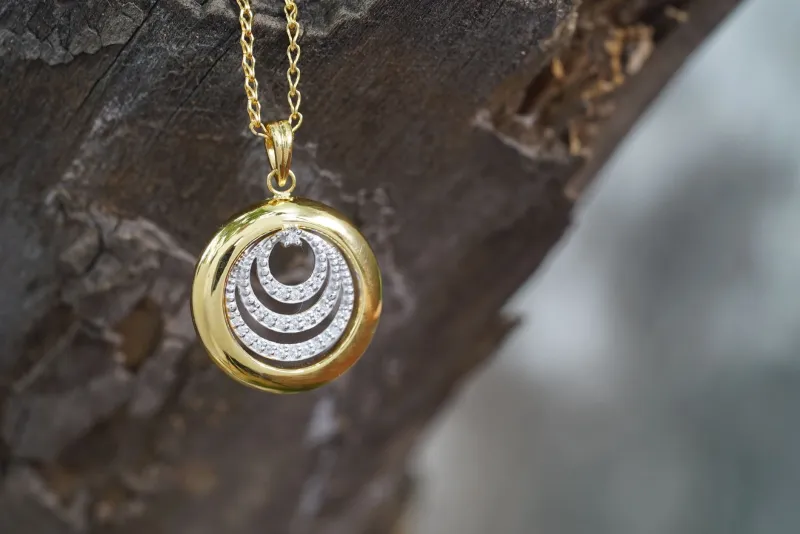
Kessler's jewelry line is built on a single, stubborn gesture: every pendant, bangle, and ring contains a void at its center. Her signature piece — a heavy brass torus with a pierced middle — reads at first like a design flaw, then like a revelation. "The hole is the jewelry," she told us. "Everything else is just the frame." Trained as a metalsmith, Kessler cites both medieval Indian temple architecture and Bauhaus ring design as influences, but her real lineage is conceptual: the bindu, the point of concentrated emptiness from which form unfolds.
2. The Sliced Silhouette: Devon Achebe, Brooklyn, New York
Achebe's garments are cut with surgical negative space — slits across the back of a coat, a seam that opens into nothing along a dress's side. A former architect, she describes her pattern-making as "drawing rooms into the body." Her Fall collection, titled Cipher, featured jackets with entire panels removed, held in shape by sheer tension alone. Critics have called the work confrontational; wearers tend to call it breathing room.
3. The Woven Absence: Hannah Larkspur, Asheville, North Carolina
Larkspur hand-weaves textiles with deliberate gaps — open warps, skipped threads, ladders of nothing running through wool and linen. Her wall pieces hang in galleries, but her scarves and shawls have become cult objects among designers. "A gap in the weave catches light differently," she says. "It's the only part of the cloth that changes all day." Her studio window faces the Blue Ridge Mountains, which she describes as "the best study in negative space I know."
4. The Unfilled Form: Theo Marchetti, Chicago, Illinois
Marchetti's leather goods — bags, belts, watch straps — are structured around empty volumes. His best-known design is a satchel whose body is a rigid open frame; whatever it carries defines its shape. "The bag is a question," he explains. "You answer it every morning." The design echoes the Indian mathematical insight that zero is not nothing but a placeholder that gives other numbers meaning.
5. The Vanishing Print: Aisha Qureshi, Santa Fe, New Mexico
A Pakistani-American print designer, Qureshi creates fabrics whose patterns dissolve into undyed ground — motifs that thin out until only cloth remains. Her collections, screen-printed in small runs, draw explicitly on Mughal manuscript margins, where empty space frames the illuminated word. "The blank ground isn't background," she insists. "It's the point. The pattern is just how you notice it."
Why the Void Sells
There is a commercial logic here that transcends aesthetics. In a market fatigued by maximalism and algorithmic noise, absence reads as luxury. Fewer elements signal more control; emptiness signals confidence. But the deeper appeal, these makers suggest, is philosophical. The zero was never merely a number — it was a way of seeing, born on the subcontinent, that treats nothing as the precondition of everything.
Worn on the body, shoonya becomes intimate: a hollow at the collarbone, a gap at the wrist, a place where the fabric simply stops. American fashion has long borrowed forms from elsewhere. What makes this moment different is that what's being borrowed isn't a shape at all — it's the space a shape leaves behind.