The Room That Holds Nothing: Shoonya and the Quiet Rebellion of the Uncluttered American Home
The Space You Didn't Fill
Walk through any American suburb on a Saturday morning and you'll hear the same refrain: a garage being emptied, a donation bin overflowing, a friend swearing off Target runs for the third time this year. We have become a nation obsessed with removing things. Marie Kondo's folded empire, the minimalism podcasts, the beige-on-beige 'quiet luxury' aesthetic flooding our Instagram feeds — all of it points toward a single craving. We want less. But we rarely ask why less feels good.
The answer, according to a philosophical tradition far older than any decluttering method, is that emptiness is not absence. It is presence of a different kind.
What Shoonya Actually Means
In Sanskrit and in the everyday spiritual vocabulary of South Asia, shoonya — the word that gave us 'zero' — refers to a fullness of emptiness. It is not a void to be feared or fixed. It is a generative space, the silence from which sound emerges, the blank ground on which every mark becomes meaningful. Indian mathematics elevated zero to a number with its own power precisely because the tradition understood something we are still learning: nothing is not nothing.
This is a difficult idea to import into a culture built on acquisition. The American home, historically, has been a ledger of arrival — every shelf a receipt of the immigrant's climb or the middle class's comfort. Empty space can read as failure. But a growing number of US designers and homeowners are discovering that the opposite is true: what you leave out is the most expensive statement in the room.
Negative Space Was Never New
Consider the rangoli, the geometric pattern drawn in pigment or rice flour at thresholds across India. Its beauty depends as much on the untouched ground around it as on the pattern itself. The margin is not leftover; it is the frame that makes the design breathe.
Or take the Mughal charbagh garden, that quartered paradise of water channels and cypress. At its heart sits not a monument but an absence — an open pool, a still plane of water reflecting the sky. The emptiest point in the garden is its most sacred. Persian and South Asian architecture built entire philosophies around the courtyard: a hollow at the center of the home through which light, air, and family life circulated.
These are not aesthetic quirks. They are design systems in which emptiness performs work — cooling, framing, focusing, sanctifying. Centuries before the KonMari method asked whether an object sparks joy, these traditions asked a subtler question: does this space need to be filled at all?
The American Translation
So what does a homeowner in Chicago or Austin actually do with this? A few principles translate cleanly across continents:
Reserve one surface that stays bare. A table, a shelf, a stretch of wall. Not as storage-in-waiting, but as a resting place for the eye. In rangoli terms, it is the margin that lets everything else register.
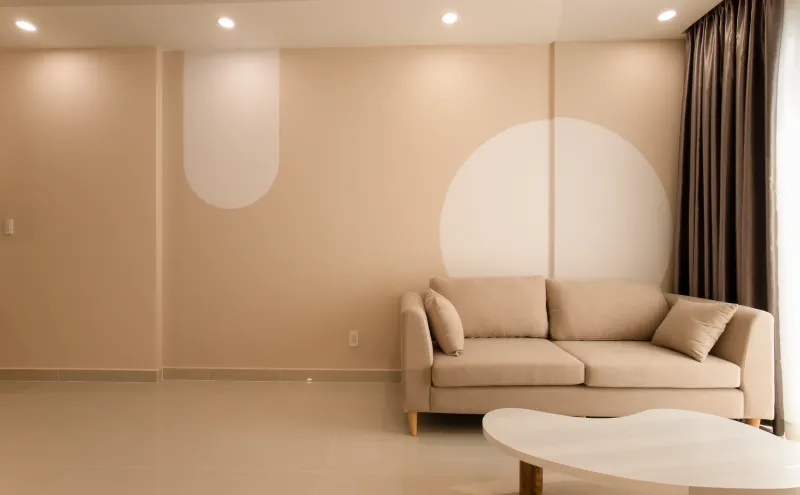
Let the center hold quiet. Borrow the logic of the Mughal pool: in your main living space, resist the instinct to anchor the room with furniture or a statement object. A rug of plain color, a low table, a window — emptiness at the center draws everything around it into focus.
Treat gaps as connections. South Asian courtyards teach that a void can link rather than divide. Leave sight lines between rooms. Let a hallway end in light rather than clutter.
Buy for the space, not the object. Quiet luxury, at its best, is not about logo-free cashmere. It is about proportion — an object given enough room around it to be seen as itself.
The Deeper Declutter
There is a reason the current American hunger for minimalism feels spiritual even to people who claim no spirituality. The home has become the last controllable landscape in an overstimulated life, and clearing it is a form of self-editing. Shoonya suggests that this editing can go further than tidying. The goal is not a home that contains the right things. It is a home in which space itself is treated as a possession — one that cannot be bought, only protected.
Zero, after all, is the number that makes every other number legible. A room that holds nothing is the room that makes everything in it count.