The Panel Left White: Inside the American Storyboard's Quietest Decision
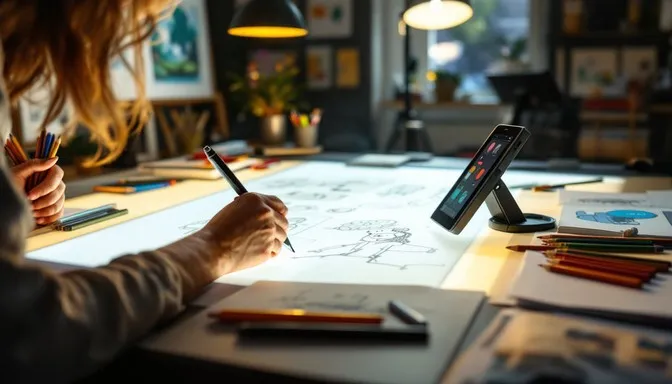
Photo: storyboard artist sketching film panels desk studio, via images.stockcake.com
The Panel Left White
On the second floor of a Burbank animation studio, a senior storyboard artist keeps a strange ritual. Before she begins a sequence, she rules out the full grid of panels — twenty-four empty rectangles on a page — and then, deliberately, leaves four of them blank. Not placeholders. Not 'to be determined.' Blank. They are moments she has decided the audience should feel without being shown.
'Everyone thinks the job is drawing,' she says. 'The job is deciding what not to draw.'
In an industry measured in deadlines and frame counts, the empty panel is a small act of resistance — and, increasingly, a deliberate craft. Across American film and animation studios, storyboard artists are reclaiming the pause, the cut, the scene that never gets shot. And many of them, whether they name it or not, are working in a tradition far older than Hollywood: the South Asian art of ellipsis.
What the Blank Panel Does
A storyboard is a film's rehearsal on paper — a blueprint of camera moves, blocking, and beats. It is also, by nature, an exercise in compression. A 120-page script becomes 400 panels; every choice is a removal.
But some artists go further. They leave gaps where a reaction shot might go. They let a confrontation resolve off-panel, in the white space between two frames. The viewer's mind supplies the violence, the forgiveness, the goodbye. The panel is empty; the scene is full.
This is not laziness. It is composition. The blank panel forces the audience to become the artist, and that act of completion is where emotion deepens. Anyone who has watched a child fill in a story gap with their own imagination knows the principle: what is withheld is what is remembered.
An Older Grammar of the Unstated
South Asian narrative traditions have long treated the unsaid as a load-bearing element. Classical Sanskrit poetics named it vakrokti and dhvani — suggestion, resonance, meaning that lives between the lines rather than in them. The miniature painters of the Rajput courts left ground untouched to signify the infinite. In the ragas, the silence between phrases is not the absence of music but part of its architecture.
The Hindi film tradition, for all its maximalism, has its own fluent silences — the glance held a beat too long, the song that says what dialogue cannot. And the philosophical concept from which this publication takes its name, shoonya — the void that is not nothing but pure potential — has always understood that emptiness is generative.
American storyboard artists encountering these traditions — through collaboration with South Asian colleagues, through the global flow of animation talent, through study — find a vocabulary for something they had been doing intuitively. The blank panel is not a gap in the work. It is the work.
Composing Absence on a Deadline
Here is the tension: pre-production is a machine. Boards are due, sequences are locked, schedules do not bend for contemplation. Leaving a panel empty can read, to a director under pressure, as an unfinished job.
The artists who practice this craft speak of the emotional weight of defending emptiness. One describes presenting a sequence with three blank panels — a mother's realization rendered as nothing but the space where her face should be — and being asked to 'just fill them in.' He held his ground. The scene, as shot, became the most discussed moment of the film's third act.
There is vulnerability in it. A drawn panel can be critiqued; an empty one can be dismissed. To leave a panel white is to stake your judgment — your sense of timing, of audience, of trust — on the claim that less will land as more. On a Tuesday, against a Friday deadline, that is an act of quiet conviction.
The Scene That Never Gets Shot
Every film is haunted by the scenes that died in the boardroom — the sequences imagined fully, boarded partially, and cut before a camera ever rolled. Storyboard artists are the only witnesses to these phantom scenes. They exist as three panels and a note in a margin, or as nothing at all.
Some artists keep personal archives of these ghosts: sequences beloved and abandoned, moments that shaped a film's rhythm even in their absence. The unshot scene leaves a scar of positive space — the film breathes differently around the hole where it would have been.
This is shoonya applied to cinema's most ephemeral document. The storyboard, meant to be discarded once production begins, becomes a record of everything a film chose not to be. And in that record, the empty panels speak loudest.
Toward a Fuller Emptiness
American audiences have grown fluent in visual restraint — the held shot, the unresolved ending, the quiet film. It is fitting that the craft upstream of all of it, the storyboard, is learning the same lesson from traditions that never forgot it.
The next time a film takes your breath away by showing you nothing — a cutaway, a held frame, a moment that resolves in the dark of your own imagination — remember the artist who, on a deadline, ruled out a grid of panels and left one of them white. The void on the page was not an omission. It was an invitation.
And you, sitting in the theater, accepted it.