Thirteen Stories Down: The Stepwells American Architects Can't Stop Measuring
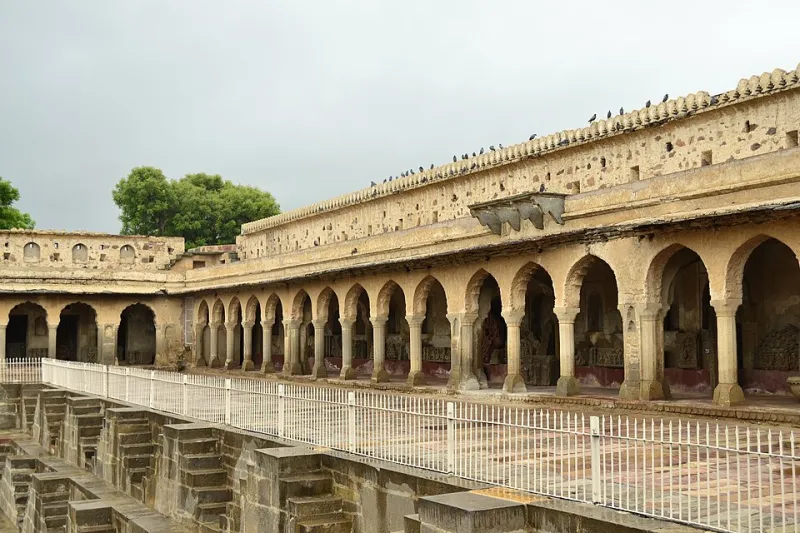
Photo: Vetra, CC BY-SA 3.0, via Wikimedia Commons
There is a particular silence at the bottom of Chand Baori that visitors describe in the same words, almost regardless of where they come from. It is not the silence of remoteness — the stepwell sits in the village of Abhaneri, Rajasthan, a few hours' drive from Jaipur, with buses and tea stalls and children selling postcards at its edge. It is the silence of proportion. Thirteen stories of stacked stone steps, roughly 3,500 of them, descending symmetrically on three sides toward a pool that has not been full in living memory. The fourth side carries a pavilion, its columns catching the slant of late-afternoon light. Stand at the base and look up, and the sky becomes a small, precise rectangle — an inversion of everything a monument is supposed to be.
For the past decade, this inversion has been quietly migrating into American architecture schools, monographs, and studio pin-up walls. The stepwell — baoli, baori, vav, depending on the region and the century — has become one of the most reproduced precedents in US design education. Not for its water system, which has largely failed or been superseded. Not for its engineering, though the engineering is extraordinary. For its emptiness.
A Precedent That Holds Nothing
The American canon of architectural precedent is crowded with structures that announce their purpose: the grain silo, the skyscraper, the suburban porch. The stepwell belongs to a rarer category — a building whose entire compositional logic is organized around a void. You do not enter a stepwell the way you enter a temple or a courthouse. You descend into it, one narrow step at a time, and the architecture reveals itself through the effort of your legs and the slow change of temperature on your skin. Scholars of South Asian water architecture have long noted that stepwells were social spaces as much as hydraulic ones — shaded refuges where travelers, women drawing water, and idle teenagers all shared the same cooled air. The form followed function, but the function was, in a sense, atmosphere.
When the groundwater tables dropped and mechanized pumps arrived, many of these wells went dry. What remained was the shell: an enormous, habitable negative space. Chand Baori, built in stages beginning around the eighth or ninth century, is the most photographed of them, but Rani ki Vav in Patan, Gujarat — a UNESCO World Heritage Site shaped like an inverted temple — and the Agrasen ki Baoli in central Delhi, wedged among office buildings, have their own American followings.
The question that interests us at Shoonya Akar is why this particular emptiness resonates now, in a country dealing with its own surpluses — of square footage, of spectacle, of built things.
The Pilgrimage Effect
Ask American architects who have made the trip, and a pattern emerges. Several describe the visit in quasi-religious terms: the long drive through Rajasthani farmland, the unassuming entrance wall that hides the scale of what's behind it, the moment the ground opens up. One New York–based designer we spoke with compared it to the first time she saw the Pantheon dome — a similar shock of geometry doing what ornament cannot. A Los Angeles architect who has led student travel groups to Abhaneri for years says the stepwell teaches something no slide deck can: that monumentality doesn't require height. It can be achieved by going down.
That lesson has practical echoes in American practice. The sunken courtyard has appeared in recent US projects from Arizona to upstate New York — libraries, museums, and campuses that carve space into the earth for shade, thermal comfort, and a changed relationship to the horizon. The stepwell is rarely credited by name in press releases, but the lineage is visible in section drawings: terraced edges, stepped seating, a cooling pit of air where a lawn might have been.
Geometry as Memory
There is a harder question underneath the aesthetic enthusiasm, and it deserves to be asked. Chand Baori is, in one sense, a ruin of infrastructure — a monument to a water system that no longer works, in a region where water scarcity is not an abstraction. Some critics worry that treating stepwells as pure form, as masterclasses in proportion and shadow, gently erases the ecological story embedded in their stones. The steps that look like Op Art from a drone's height were built, generation after generation, because people needed water and the water kept moving.
The most thoughtful American designers seem aware of this tension. A few describe the stepwell less as a style to borrow than as an ethic to absorb: build for shade, not for spectacle; let the section do the work the facade usually does; design spaces whose beauty survives the loss of their original purpose. That last idea — the monument that remains generous even after its function drains away — may be the stepwell's deepest lesson for a country rethinking its own aging infrastructure. Bridges, reservoirs, parking structures: what will our utilitarian voids look like when their purposes shift?
Descending as a Design Act
American architecture is, culturally, an architecture of arrival. You enter at grade, you rise, you look out. The stepwell reverses every one of those instincts. You enter at the top and disappear. The destination is the bottom, and the bottom is darker, cooler, and quieter than the world above. It is a compositional strategy, but it is also a state of mind — a willingness to make the most significant space in a project the one you have to work to reach.
Shoonya, the emptiness at the center of our name, is often mistaken for absence in the passive sense. The stepwells argue otherwise. Their emptiness is engineered, load-bearing, and social — a void deep enough to hold a village's worth of shade. Thirteen stories of nothing, and every step of it deliberate.
Perhaps that is why the American pilgrimages continue. The wells no longer hold water. They hold something harder to pump: a demonstration that the most profound thing a building can contain is the space it refuses to fill.