Seven Visions of the Void: South Asian Artists Who Make Emptiness the Star of the Show
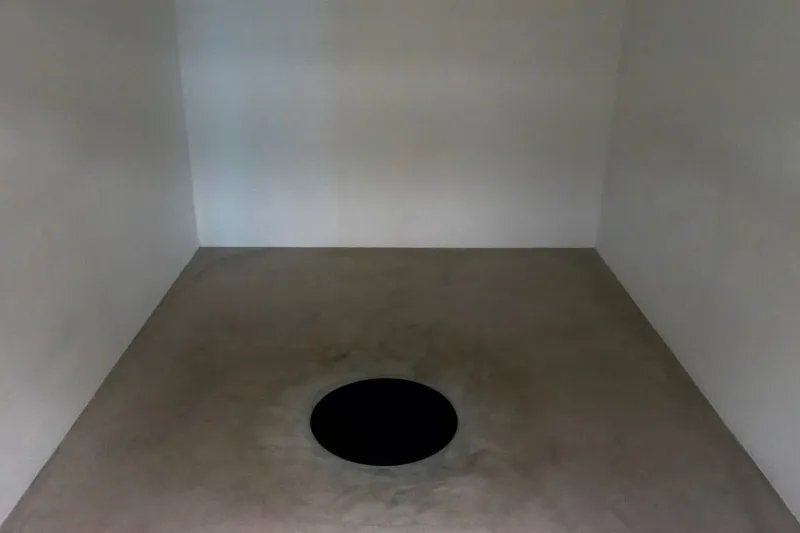
Minimalism is having an American moment — again. But for artists of South Asian descent, working the void is less a trend than an inheritance. The concept of śūnya runs through their practices like a family resemblance: sometimes explicit, sometimes subterranean, always generative. What follows is a field guide to seven contemporary artists and designers whose engagement with silence, space, and absence is producing some of the most compelling work crossing the Pacific right now.
1. Zarina Hashmi's Quiet Cartographers, Continued
The late Zarina Hashmi, who spent most of her life in New York, remains the touchstone. Her woodblock prints and paper sculptures mapped homesickness itself — cities reduced to thin lines, homes to rectangles of handmade paper. Hashmi treated emptiness as a material: what was missing (home, language, country) was always the subject. Her retrospective traveled to the Guggenheim, and her prints remain accessible through galleries like Luhring Augustine in Manhattan. For newer collectors, her editions on paper are a rare entry point into blue-chip abstraction.
2. Lala Rukh's Rhythmic Erasures
The Pakistani artist Lala Rukh (1948–2017) made drawings that feel like held breath. Her Hieroglyphics series — graphite on black paper, marks appearing and disappearing as the light shifts — turns the act of seeing into an exercise in patience. Her work, shown posthumously at Documenta 14 and held by institutions including the Tate, reminds US audiences that erasure can be as assertive as inscription.
3. Shezad Dawer's Sonic Voids
British-Bangladeshi artist Shezad Dawer works where sound runs out. His drawings translate music — often North Indian classical ragas — into spiraling, obsessive notation that stops just short of the picture's edge. The emptiness at the rim is the silence the music came from and returns to. Dawer's work appears in the collections of the Metropolitan Museum of Art and the British Museum; US viewers can often catch his drawings in group shows at the Met's modern wings.
4. Amba Sayal-Babu's Architectural Absences
Working between London and Jaipur, Sayal-Babu builds fragile structures — wire, pigment, projection — that suggest buildings not yet built or already demolished. Her installations stage absence as architecture: the room is defined by what isn't there. She has shown at the Tate Modern and in New York project spaces, and her works on paper are increasingly available through platforms like Tiwani Contemporary.
5. Nalini Malani's Shadowed Histories
A pioneer of Indian new media, Malani fills darkened rooms with rotating shadow projections — but the darkness is not backdrop; it is collaborator. Her shadow plays, inspired by the ancient tholubommulata leather puppet tradition, make emptiness the screen on which memory projects. Winner of the 68th Venice Biennale's Golden Lion for Lifetime Achievement, her installations have appeared at the Museum of Modern Art and the Peabody Essex Museum in Salem, Massachusetts.
6. Suki Seokyeong Kang's Gridded Silences — and the South Asian Echo
While Korean rather than South Asian, Kang's grids of weighted geometry have opened American gallery doors for a generation of diasporic artists exploring related terrain. The relevant point for US collectors: the appetite for spatial restraint is global, and South Asian voices are entering the same conversation. Watch for younger Indian and Pakistani abstract painters — names like Rana Begum, whose hovering metallic reliefs turn repetition into meditation — appearing alongside them in fairs from Miami to Marfa.
7. The Typographic Deconstructionists
Finally, a design collective worth watching: a loose wave of South Asian graphic designers — including studios like IKKO Tanaka-inspired type labs and independent practitioners in Mumbai and Bengaluru — who are pulling Devanagari, Urdu, and Tamil letterforms apart to study the space inside the letter. The counter (the enclosed emptiness of a character) becomes the design. Their posters and typefaces surface on platforms like It's Nice That and in exhibitions at the Cooper Union and RISD, and their typefaces are frequently downloadable or licensable — the most affordable way to bring this philosophy into your own home.
Where to Begin
For US readers wanting a starting point: the Asia Society and the Rubin Museum in New York regularly program contemporary South Asian work; the South Asia Institute in Chicago and the Asian Art Museum in San Francisco are building serious collections. Online, Artsy and 1stDibs list works by many of these artists, and print editions by Hashmi's estate and Begum remain within reach of new collectors.
Emptiness, it turns out, travels well. All it asks of the viewer is the one thing hardest to give in a scrolling age: a moment of stillness. These seven artists — and the tradition behind them — are betting that we're ready.
